

Holy Communion
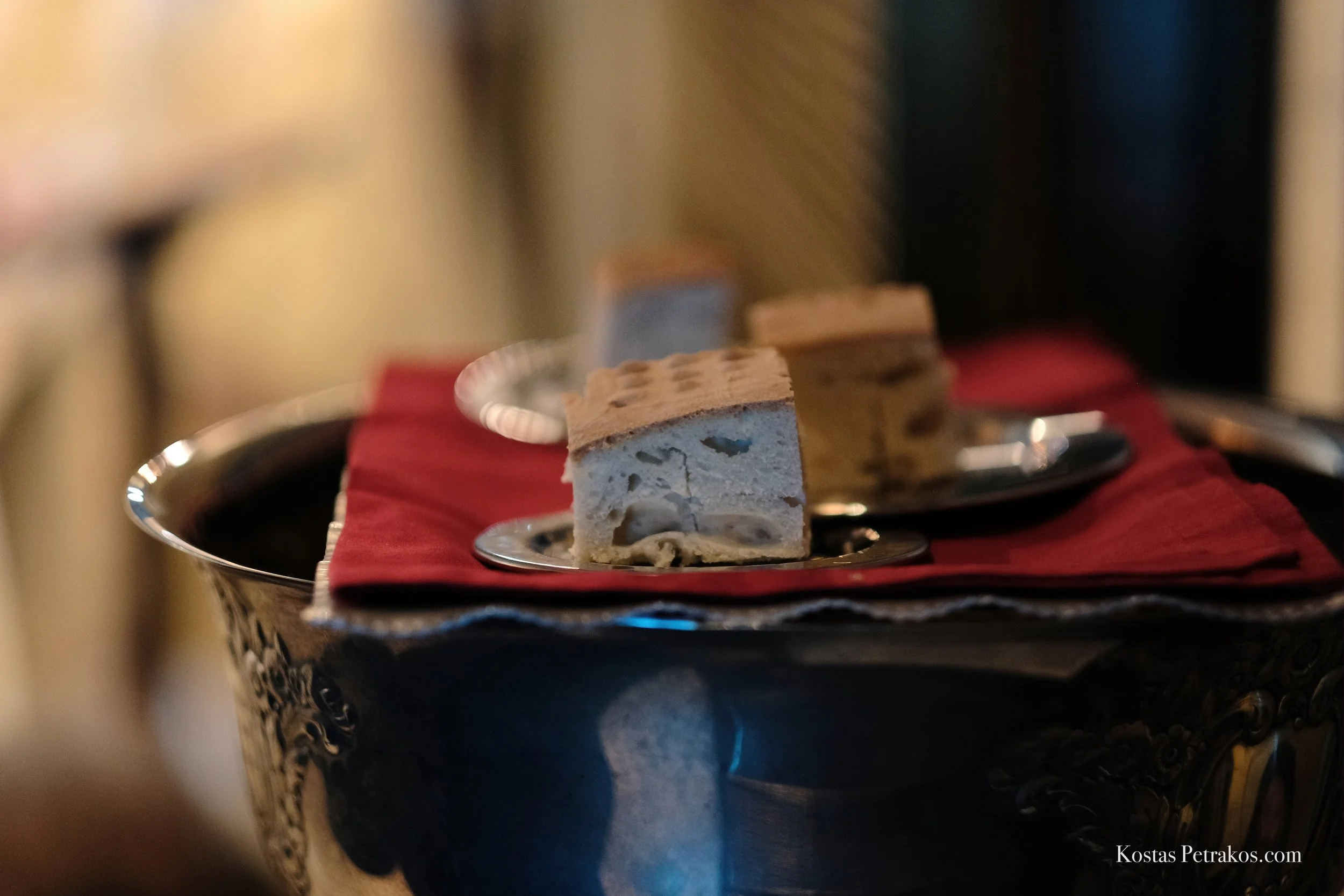
The Mystery of Mysteries: Holy Communion
"O taste and see that the Lord is good." (Psalm 34:8)
Mystical Union with Christ
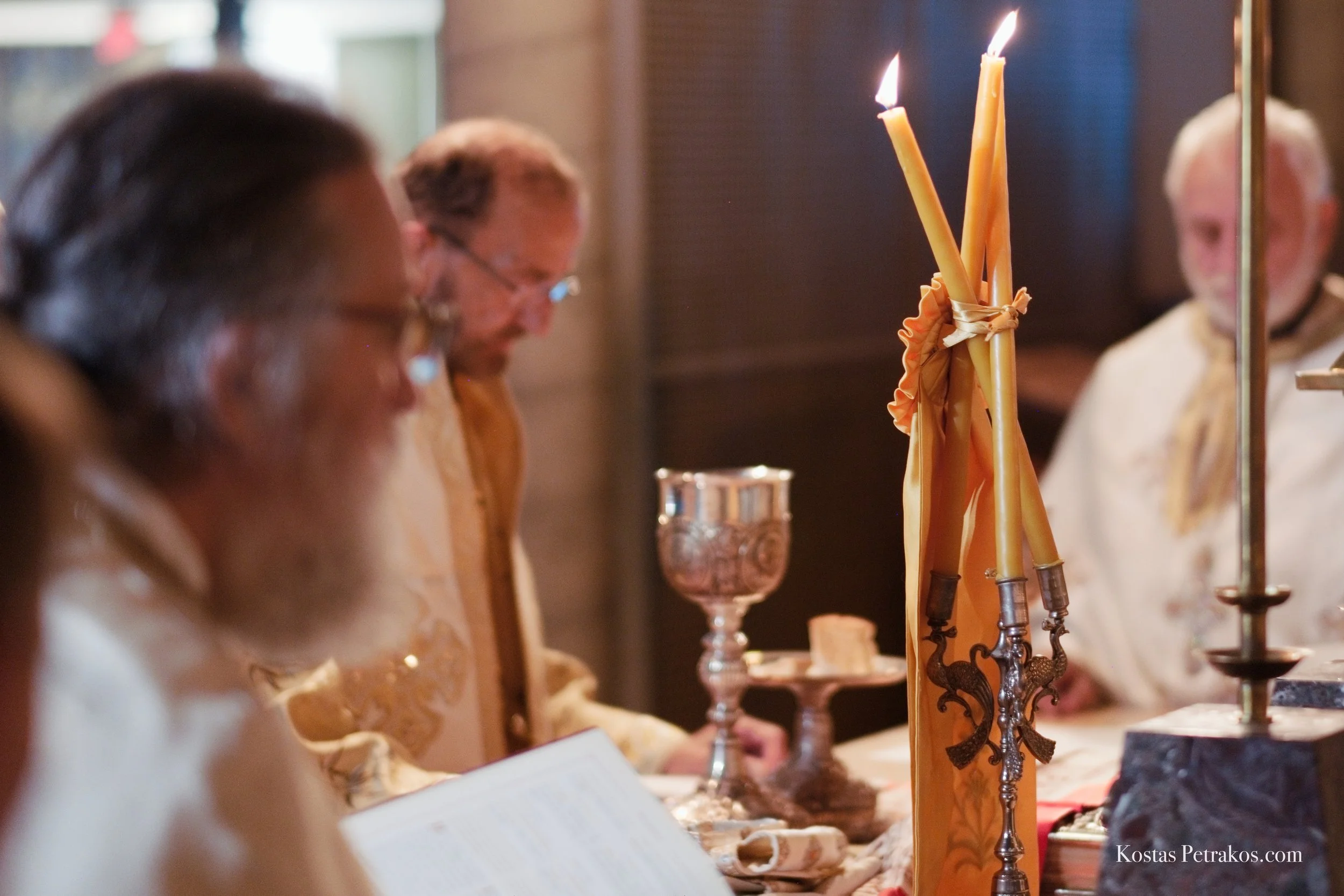
Each Sunday, at the heart of our worship, at the high point of the Divine Liturgy, something extraordinary happens: bread and wine, which have been especially prepared and offered by the people of God become, truly and mystically, the Body and Blood of Jesus Christ. The clergy bring it forth from the Holy Sanctuary. The faithful approach and partake. In so doing, we the faithful are united with our Lord and God and Savior, Jesus Christ, and with each other.
We call this Holy Communion, because it is a profound communion with our Lord and Savior, and a spiritual and physical incorporation of Christ into our being, body and soul, even as we live more deeply in Him and image Him more clearly to the world, by His Grace. It is for us, life, and for the world through His Church, light. It is also communion with our fellow Orthodox Christians from every parish anywhere in the world, and with the entirety of the Church from all ages, because the Body of Christ is One. Time and space and even the veil of death are not impediments to the unity actualized through Holy Communion.
We call it the Holy Eucharist also, which is derived from the Greek word eucharistia (ef - ha - ree- STEE - a) meaning thanksgiving. An apt description, for what greater cause for gratitude have we than that God became man and walked among us and delivered us from our bondage to sin death, and the devil, and prepared for us the inheritance of the Kingdom and the hope of participation in the Divine Life? Even more so since He continues to work out this great deliverance through His perpetual self-offering for our sake. This self-offering of the Savior is made especially concrete for us in the celebration of the Holy Eucharist, of which we partake for the remission of sins and for life everlasting. Truly, a cause for thanksgiving.
To be clear, we don't treat this moment as a mere signpost indicating some abstract spiritual ideal or simply as a recounting of a particular historical moment out of our collective past. We believe that in the Divine Liturgy, by the will of God the Father and the descent of the Holy Spirit, the bread and wine truly become Jesus Christ Himself, our Risen and Ascended Lord. Offered so that we might be joined to Him and to one another as one Body. The Body of Christ, which is the Church, and that in and through Him, we may be purified and sanctified, that we may one day rise and ascend with Him.
-
You won't find Orthodox Christians debating the mechanics of how the bread and wine change.
We call this a mystery, something to be entered into and experienced from within, not a puzzle
to be solved or a problem to be analyzed from a “safe” distance.
Our focus is not on analyzing the miracle, but on receiving it: with repentance and humility, with
faith and with love, and with the natural fear and awe of one recognizing the magnitude of the
gift they are about to receive.
The Very Reverend Fr. Thomas Hopko, a renowned Orthodox priest, theologian, and teacher of
blessed memory, wrote, "Every moment of a Christian's life is a preparation for the encounter
with God which is sacramentally realized in Holy Communion."
It is this encounter that becomes the nexus around which we structure our lives, because it is
not merely one devotional practice among many, it is the beating heart of our life in Christ. Holy
Communion is the mystery of encounter with Christ into which all the other holy mysteries of the
Church both unfold and have their grounding.
-
Christ Himself taught us just Who He is and what He offers and it is recorded in Holy Scripture:
"Do not work for food that spoils, but for food that endures to eternal life, which the Son of Man will give you. For on him God the Father has placed his seal of approval" (Jn 6:27).
"I am the bread of life. Whoever comes to me will never go hungry, and whoever believes in me will never be thirsty" (Jn 6:35).
This teaching reaches its zenith later in the same chapter, when Jesus tells the crowd in Capernaum:
"I am the living bread that came down from heaven. Whoever eats this bread will live forever.
This bread is my flesh, which I will give for the life of the world" (Jn 6:51).
The crowd was scandalized at this. "How can this man give us his flesh to eat?" they asked.
Jesus did not soften His words or explain them away but He repeated them more forcefully still:
"Very truly I tell you, unless you eat the flesh of the Son of Man and drink his blood, you have no life in you. Whoever eats my flesh and drinks my blood has eternal life... For my flesh is real food and my blood is real drink. Whoever eats my flesh and drinks my blood remains in me, and I in them" (Jn 6:53–56).
Many who heard Him say these things walked away. "This is a hard teaching. Who can accept it?" (Jn 6:60)
Orthodox Christians have never tried to make it an easy one.
-
Christ taught this to his disciples, and then sent them out to the nations of the world. Among the greatest of them was Saint Paul, whose missionary journeys are legendary, and the letters he wrote to various church communities are included in the canon of Holy Scripture and provide an apostolic testimony as to the centrality of Holy Eucharist in the life of the Church. St. Paul's main teaching on Holy Communion can be found in his First Letter to the Corinthians, where he addresses the church directly on the subject.
He offers the institution narrative, which he says he received directly from the Lord:
"For I have received of the Lord that which also I delivered unto you, That the Lord Jesus the same night in which he was betrayed took bread: and when he had given thanks, he brake it, and said, Take, eat: this is my body, which is broken for you: this do in remembrance of me.
After the same manner also he took the cup, when he had supped, saying, This cup is the new testament in my blood: this do ye, as oft as ye drink it, in remembrance of me. For as often as ye eat this bread, and drink this cup, ye do shew the Lord's death till he come" (1 Cor 11:23-26).
In the same letter, he offers a warning about receiving unworthily:
"Wherefore whosoever shall eat this bread, and drink this cup of the Lord, unworthily, shall be guilty of the body and blood of the Lord. But let a man examine himself, and so let him eat of that bread, and drink of that cup. For he that eateth and drinketh unworthily, eateth and drinketh damnation to himself, not discerning the Lord's body" (1 Cor 11:27-29).
He describes communion as participation in Christ and as the sign of the Church's unity:
"The cup of blessing which we bless, is it not the communion of the blood of Christ? The bread which we break, is it not the communion of the body of Christ? For we being many are one bread, and one body: for we are all partakers of that one bread" (1 Cor 10:16-17).
The Apostle Paul, writing his first letter to the Corinthians, witnesses to an orthodox understanding of the Eucharist as the literal Body and Blood of Christ rather than a mere sign pointing to a distant historical moment or a theological abstraction. He describes this sacred mystery as a true communion with Christ's physical reality, which serves to bind believers together into one body, while also acting as a profound proclamation of the Lord's death until His return.
He emphasizes that the profound sacredness of this communion with God calls for proper preparation through self-examination, as improper participation is considered a profanation of the Divine, which directly informs the fasting and confession practices within the Orthodox Church.
-
A generation later, St. Ignatius of Antioch (also known as Theophoros, "the God-Bearer"), writing around 107 AD on his way to martyrdom in Rome, speaks about the Eucharist in several of his seven authentic letters. Here are key passages:
He writes in his Letter to the Smyrnaeans (6:2–7:1) of the Eucharist being the real flesh of Christ:
"They abstain from the Eucharist and from prayer, because they confess not the Eucharist to be the flesh of our Saviour Jesus Christ, which suffered for our sins, and which the Father, of His goodness, raised up again. Those, therefore, who speak against this gift of God, incur death in the midst of their disputes."
And in the same letter, one can see the saint is concerned about Eucharistic order and the bishop:
"Let that be deemed a proper Eucharist, which is [administered] either by the bishop, or by a person he has appointed" (8:1).
In his Letter to the Ephesians he describes communion as a source of life:
"...breaking one and the same bread, which is the medicine of immortality, and the antidote to prevent us from dying, but [which causes] that we should live forever in Jesus Christ" (20:2).
While in his Letter to the Philadelphians he speaks to the Eucharist being a sign of the unity of the Church:
"Take heed, then, to have but one Eucharist. For there is one flesh of our Lord Jesus Christ, and one cup to [show forth] the unity of His blood; one altar; as there is one bishop, along with the presbytery and deacons, my fellow-servants: that so, whatsoever you do, you may do it according to [the will of] God" (4).
And in his Letter to the Romans written as he anticipated being martyred, he expresses longing for union with Christ in terms of the Eucharistic elements:
"I have no taste for corruptible food nor for the pleasures of this life. I desire the bread of God, which is the flesh of Jesus Christ, who was of the seed of David; and for drink I desire his blood, which is love incorruptible" (7:3).
St. Ignatius’ letters witness to the fact that the Christians of the first centuries, even as early as the first generation after the Apostles, held the Holy Eucharist to be at the heart of true worship and to be truly the Body and Blood of Christ. They knew it to be from the Apostles, and the Apostles knew it from Jesus Christ. And the Church has held to this doctrine, unflinchingly, through the ages.
Visitors
Holy Communion is reserved for baptized and chrismated Orthodox Christians who have prepared through prayer, fasting, and, as needed, Confession, since coming to the chalice is coming as a full member of the Body of Christ rather than a private transaction between an individual and God.
If you're not Eastern Orthodox Christian, please don't feel excluded. You may remain in the pews respectfully or come forward with everyone else and ask for a blessing from the priest instead of receiving the Eucharist. Otherwise, we welcome you to the Cathedral of the Ascension and we hope to see you
at Coffee Hour next door!